



Wednesday 28th January

Their, there, they're
‘there’ refers to a place or position.
‘their’ is a possessive adjective. This means it shows ownership or belonging.
'they’re’ is a contraction. This means it is a shorter way of saying ‘they are’
Complete these sentences with the correct word - there, their or they're.
RIC:
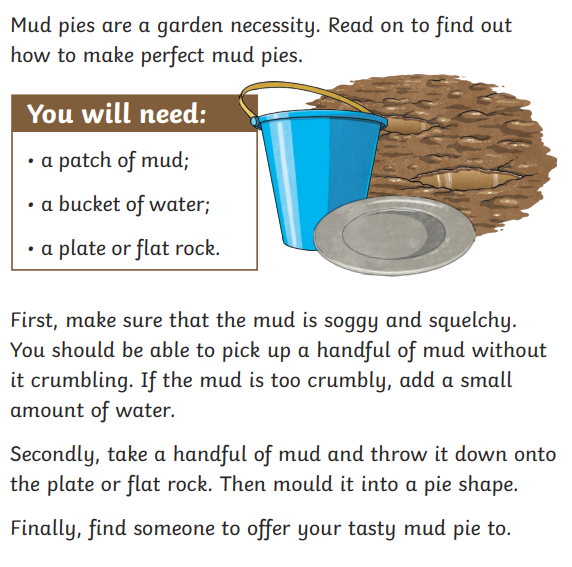
R: What are these instructions for?
I: Why might you need to add a small amount of water to the mud?
C: Explain how the author has made these instructions easy to follow
Wednesday 28th January 2026
LC: To answer questions by making a point and supporting it with evidence from the text.
Recap:
⭐ What is a POINT?
A point is what you think.
It answers the question clearly.
⭐ What is EVIDENCE?
Evidence is proof from the text.
It might be a word, phrase, or sentence that supports your point.
Teacher model:
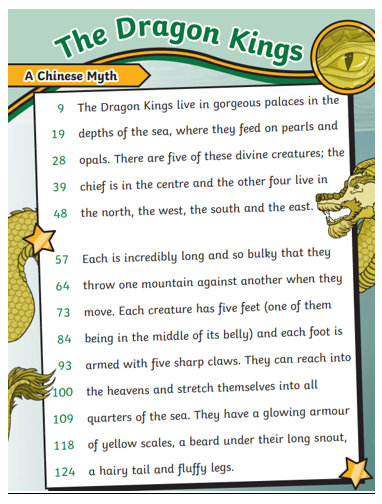
What does the phrase “gorgeous palaces” suggest about where the Dragon Kings live?
Point:
It suggests that the Dragon Kings live in a beautiful and grand place.
Evidence:
The text says they live in “gorgeous palaces,” which shows their home is impressive and special.
Your turn: Find evidence from the text to support the point.
In what ways might the Dragon Kings appeal to readers?
Point:
The Dragon Kings might appeal to readers because they are powerful and exciting creatures.
According to the text, how many Dragon Kings are there and where do they live?
Point:
There are five Dragon Kings, and each one lives in a different part of the sea.
Explain fully why the Dragon Kings are described as dangerous.
Point:
The Dragon Kings are described as dangerous because they are huge and heavily armed.
Adapted: Sentence starters:
This is shown in the text when it says…
This suggests that…
The evidence for this is…
This shows…
Adapted:
LC: To explain what is being read to them in non-fiction
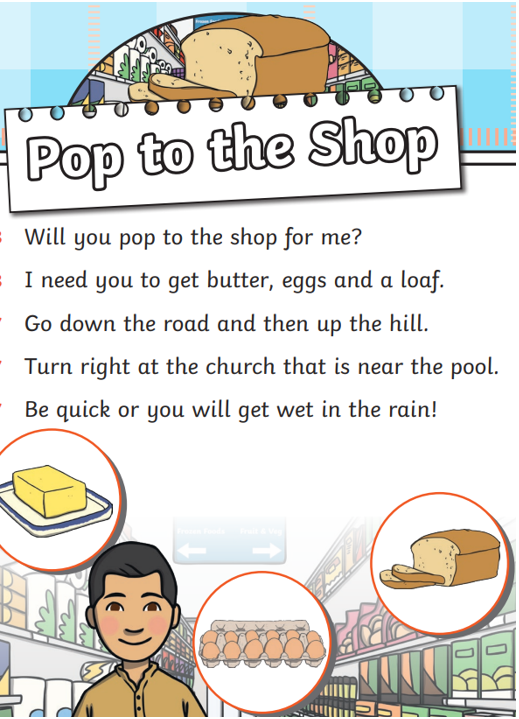
What has the person bought from the shops?
What will they make with some of the shopping?
When you go to the shops what do you and your family buy?
Wednesday 28th January
Produce an effective information leaflet.
Today you will complete your leaflet. Have you checked all of the grammar and spelling? Is there anything you need to do to improve how your leaflet looks.

28.01.26
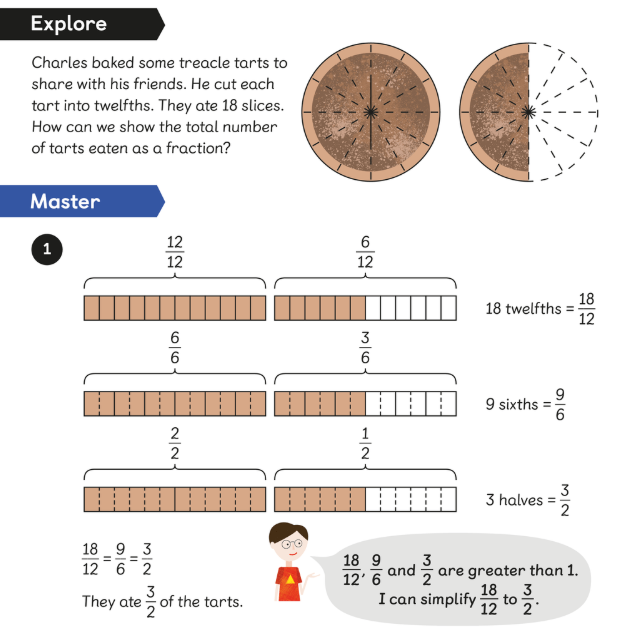
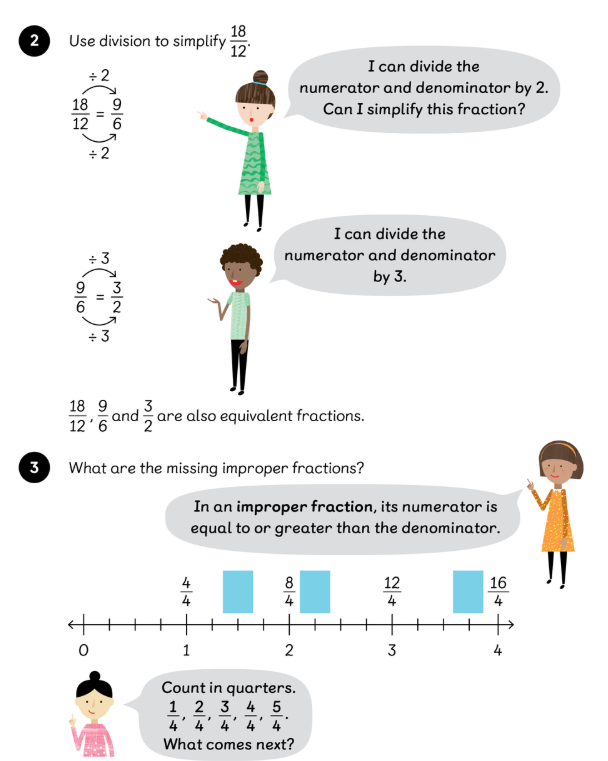
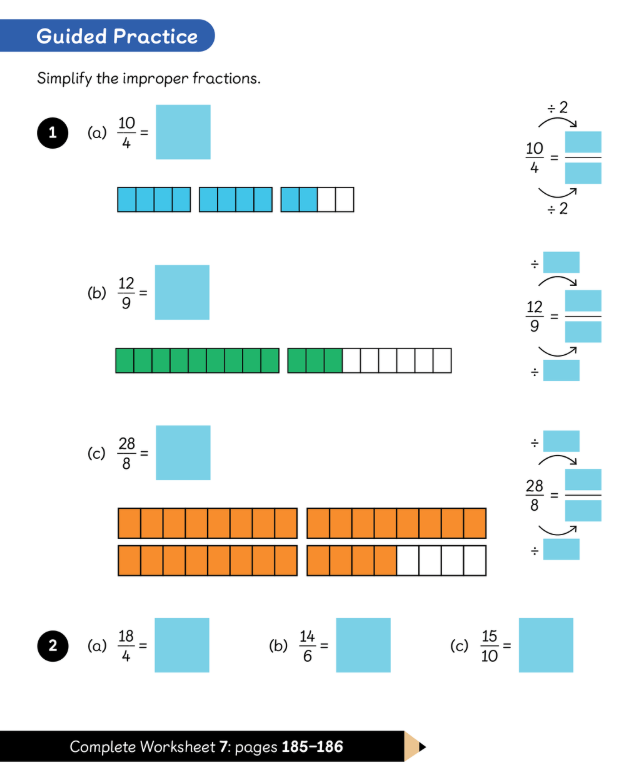
LC: To be able to simplify improper fractions.
Adapted:
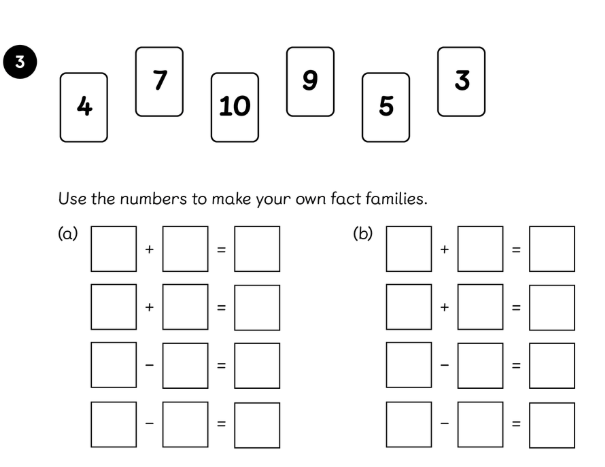
LC: Subtraction and addition families.
Review
Can you remember what a prefix is?
Quick Write
Listen to me say and watch me write a focus word. Can you write the word with your finger in the air? Can you write the word with your finger on the table? Quickly write the word on your whiteboard. Now lets do the same with some more words. How many words can we 'quick write' in one minute? Hold up your whiteboards and we'll check they are spelled correctly.
invisible
insert
incomplete
impolite
impossible
immature
inappropriate
independent
Remember
in- and im- are prefixes that originate from Latin.
They can mean both 'not' and 'in' or 'into'.
On rare occasions, they can mean 'on'.
If a root word starts with m, p or b, the prefix in- becomes im-.
(The prefix im- is actually just a variation of the prefix in-. It changes mainly to make words easier to say and smoother to pronounce.)
Learning:
Focus: Add the prefix ir-, e.g. irregular.
ir- is a prefix that originates from Latin.
Like the prefix im-, ir- is a variation of the prefix in-,
Like in-, ir- means not or it can also mean without.
Read the sentences below with me. Can we use the context to work out the meaning of the 'ir' words?
The buses are irregular on a Sunday.
It was irresponsible to leave the medicine out where the baby could reach it.
Grandma's necklace is her prized possession – it is irreplaceable.
It was irrational to suppose the dog could do my homework.
The special chocolate cake was irresistible.
The weather outside is irrelevant to our history lesson.
Can you identify the root word in each case? What do you notice about them?
If a root word starts with r, we use the prefix ir-.
We use it mainly to make words easier to say and smoother to pronounce.
Practise and Apply
Use the Sticky Word Strategy – Colourful Words to write the correct spelling of each of these words in your journal. Write the prefix in one colour and the root word in another.a
irregular
irresponsible
irrelevant
irreplaceable
irresistible
irrational
irreversible
irreparable
Our Amazing World
Aims
To encourage children to reflect on and marvel at the world around them.
Assembly
- Here are some amazing facts about animals. Did you know:
that a cheetah can run up to 70mph?
that if a sloth dropped down to the ground from its tree, it would be completely helpless as its long claws would prevent it from walking?
that camels have long eyelashes to protect their eyes from blowing sand?
that it is possible for all the female bats in one cave to give birth at the same moment?
that tree frogs have sticky pads on their feet for clinging to vertical surfaces? - Christians believe that our amazing world and all that is in it was created by an amazing God.
In your Talk Partners:
Think of your favourite animal and tell the person on your right.
Think of your favourite flower and tell the person on your left.
Think of your favourite fruit or vegetable and tell the person in front of you.
Think of your favourite part of creation (e.g. mountain, sea, sky) and tell the person behind you. - Explain that you wish you could have heard all their different answers. What a lot of different answers there must have been! Christians like to give thanks to God for the variety in nature, for so many different plants, animals and features of the earth and space.
Time for reflection
Reflection :
Imagine a world where many of these animals can no longer be found. Every day, more and more species become endangered through poaching and destruction of habitat – human greed.
Imagine a world where trees, plants and flowers are stripped of life. Every day, more and more vegetation is destroyed through industry and pollution – human greed.
Imagine a world where climates are changing, landscapes are being rewritten. Every day, earthquakes, hurricanes and other natural disasters bring destruction, triggered by global warming and pollution – human greed.
What kind of world are we helping to create?
Prayer :
Dear God, we thank you for zebras and penguins, parrots and chameleons.
Dear God, we're sorry for hunting and hurting, for extinction and neglect.
Dear God, help us to care for the animals around us and to appreciate the wonder of all the beings that you have made.
Dear God, we thank you for monkey puzzle trees and brussels sprouts, roses and strawberries.
Dear God, we're sorry for acid rain, pesticides, the destruction of forests.
Dear God, help us to care for rather than destroy.
Dear God, we thank you for mountains and icebergs, waterfalls and all the amazing variety of nature.
Dear God, we're sorry for poisoned rivers, industrialization of the countryside, changing landscapes.
Dear God, help us to take care of our own environment and to speak out against the destruction of your world.